
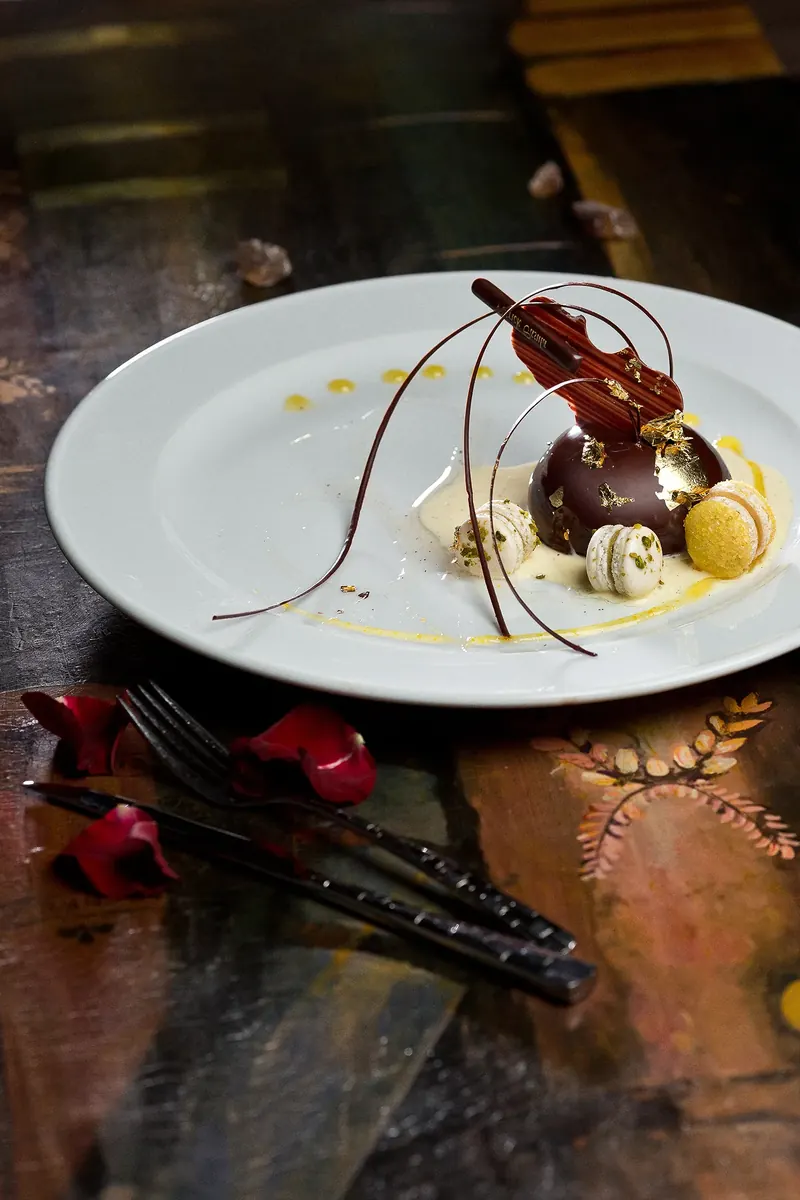
Dark Chocolate "Supreme" with Hazelnuts and Coffee-Orange Sauce is an elegant dessert that combines rich dark chocolate with the satisfying crunch of hazelnuts. The coffee-orange sauce adds a bold contrast to the deep, bittersweet chocolate, making this a dessert that truly excites the palate. With its complex flavors, this dessert is perfect for special occasions like holiday dinners, celebrations, or an indulgent treat on a cool evening. The combination of coffee's warmth, orange's zest, and chocolate's decadence makes it ideal for the colder months, particularly in fall and winter when the rich, comforting flavors are most appreciated.
Ingredients
Method
- Soak the 1½ gelatin sheets for the jelly in cold water for 5 minutes.
- Stir the sugar and orange zest into the hot coffee until the sugar dissolves.
- Squeeze the gelatin and stir it into the coffee until dissolved.
- Pour a 1 cm layer into 6 compartments of the ice-cube tray and the rest into a small container, and refrigerate for 1 hour, until set.
- Heat the cream for the hazelnut cream until steaming.
- Whisk the yolk with the sugar, pour in the hot cream, return to the pan and stir over low heat until it coats a spoon, 82°C (180°F).
- Whisk the custard into the hazelnut paste with the vanilla until smooth.
- Let it cool, spoon it over the set coffee jelly and freeze the tray for at least 2 hours.
- Heat the oven to 160°C (325°F).
- Rub the butter, cane sugar and ground hazelnuts together into a dough.
- Roll the dough between two sheets of baking paper to 3–4 mm thick.
- Slide it, on its bottom sheet, onto the baking sheet, peel off the top sheet and bake for 10–12 minutes, until golden all over.
- Let it cool for 2–3 minutes, then cut six 7–8 cm discs with the cutter while it is still warm and soft; leave them to harden.
- Line the teacups with cling film, letting it hang over the rims.
- Soak the gelatin sheet for the chocolate cream in cold water and put the chopped chocolate in the heatproof bowl.
- Bring the milk to the boil.
- Whisk the 3 yolks with the sugar, pour in the hot milk, return to the pan and stir over low heat to 85°C (185°F).
- Pour the custard over the chocolate, add the squeezed gelatin and stir until smooth.
- Let the chocolate mixture cool to about 40°C (104°F), warm to the touch.
- Whip the cold cream to soft peaks and fold it into the chocolate.
- Spoon the chocolate cream into the lined cups until about two-thirds full.
- Pop the frozen cores out of the tray and press one into the centre of each cup, jelly side down.
- Cover with the remaining chocolate cream and smooth the tops.
- Lay a hazelnut disc on each and press lightly; it will become the base.
- Freeze for at least 4 hours.
- For the custard sauce, heat the milk and cream with the vanilla pod until steaming.
- Whisk the yolks with the sugar, pour in the hot milk and cream, return to the pan and stir over low heat until it coats a spoon, 82°C (180°F).
- Strain the sauce, let it cool and refrigerate it.
- Turn the domes out onto a tray, peel off the film and refrigerate them for 1–2 hours to soften.
- Dust the domes lightly with cocoa.
- Set a dome on one half of each plate and spoon the vanilla sauce over the other half.
- Cut the leftover coffee jelly into small cubes and scatter a few on each plate.
- Add dots of marmalade and a small scoop of vanilla ice cream, and serve.
- Hazelnut Crust:
- Combine cold butter and sugar. Add hazelnuts and mix.
- Roll out between 2 sheets (about 4mm thick).
- Freeze.
- Cut into circles with a diameter for 1 cm less than a ring for assembly dessert.
- Bake at 160 ° C
- Hazelnut "supreme":
- Whisk the yolks with the sugar. Infuse in vanilla cream and bring to a boil.
- Strain and pour over the hazelnut pasta. Cook at 85 °.
- Add the soaked gelatine. Blend and pour into a 3cm in diameter silicone mold. Freeze.
- Light chocolate cream:
- Whisk the yolks with the sugar, add the boiling milk and cook at 85 °.
- Pour over chocolate. Add gelatin and blend.
- Cool to 40 ° C, then stir in the cream.
- Coffee jelly:
- Combine coffee with the sugar, orange zest and gelatin. Pour into silicone molds and freeze at supreme.
- English vanilla cream:
- Infuse vanilla in milk and cream.
- Whisk the yolks with the sugar and cook all together up to 85 °.
- Beat in the blender.
- Vanilla sauce:
- Boil water with sugar and vanilla.
- Add gelatin. Refrigerate the mixture.
- Assemble
- Transfer chocolate cream into hemispheres.
- Put the hazelnut "supreme" on a coffee jelly.
- Cover with yhe chocolate cream and hazelnut crust.
- Freeze.
- Remove from molds and glaze
- Serve
- Put the chocolate and hazelnut hemisphere on one half of the plate.
- Decorate the other side with vanilla sauces and English vanilla cream.
- Add orange confit drops and vanilla ice cream.
What we changed for home
- Scaled from about sixty portions to six The chef's chocolate cream alone uses 1.5 kg of chocolate and 1.2 litres of milk.
- Silicone hemisphere and 3 cm moulds replaced with six teacups or small round bowls lined with cling film, and an ice-cube tray for the cores Both give the same dome with a hidden centre; the film lets the frozen domes slide out.
- Coffee jelly made with 100 ml coffee, 25 g sugar and 3 g gelatin, instead of 50 ml coffee, 120 g sugar and 15 g gelatin The original proportions give a syrup that sets as hard as a gummy sweet and tastes mostly of sugar. With less sugar and gelatin the coffee and orange come through and the jelly stays tender.
- Hazelnut 'supreme' simplified to a small hazelnut custard frozen in the ice-cube tray The chef's version uses only a trace of gelatin, so it is essentially a soft hazelnut cream held by freezing. A cooked yolk custard with hazelnut paste does the same at home.
- Hazelnut crust baked as one thin sheet and cut into discs while still warm Butter, sugar and nuts with no flour spread in the oven; cutting the warm sheet gives neat discs.
- Two vanilla sauces reduced to one vanilla custard; orange confit replaced with orange marmalade; glaze replaced with a dusting of cocoa The vanilla syrup sauce adds little beside the custard. Orange confit and the glaze are not described in the recipe, and marmalade and cocoa give the same accents.
- Domes thawed in the fridge for 1–2 hours before serving Straight from the freezer the chocolate cream is hard; it is meant to be eaten chilled and soft.
The dish in the photograph was cooked by the restaurant for this story. Photo: Oleksandr Slyadnyev.
Screen stays on while you cook