
Stefano Rossi · Hong Kong
Agnolotti del Plin with Castelmagno, Butter and Sage
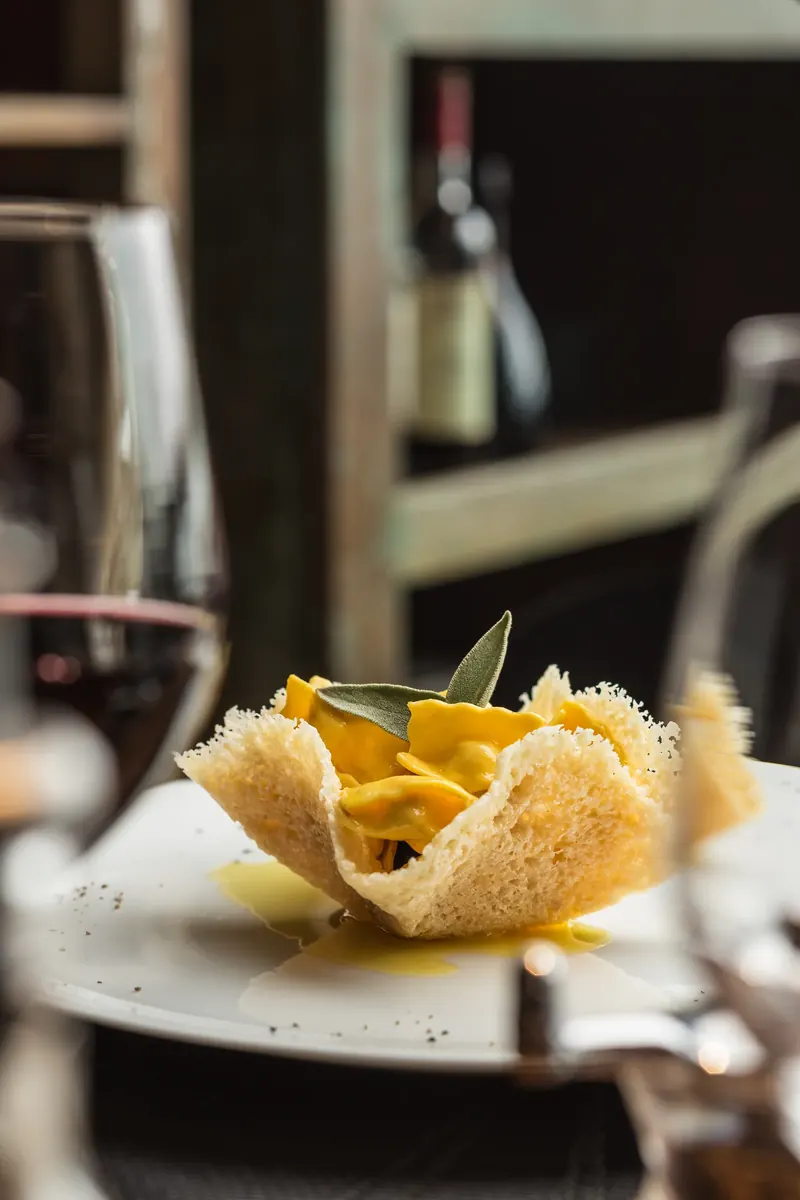
There are so many pasta lovers in the world. Some of them just play with different spices to create interesting flavors, someone surfs an internet for the classic pesto recipe, and others buy a pasta maker, and know all kinds of pasta. But all of them have a mutual feature – each of these types of cooks just loves Italian pasta.
This recipe is just for them.
Ingredients
Method
- Heap the flour on the work surface or in the bowl and make a deep well in the centre.
- Crack the eggs into the well and beat them with a fork, drawing in the flour little by little until a shaggy dough forms.
- Knead for 8–10 minutes, until the dough is smooth and springs back when pressed; if it stays crumbly, wet your hands and keep kneading, adding no more than 1 tbsp of water in all.
- Wrap the dough in cling film and leave it at room temperature for 30 minutes.
- Meanwhile, put the ricotta in the lined sieve over a bowl and let it drain in the fridge.
- Mix the Castelmagno, drained ricotta and egg with a fork until smooth.
- Season the filling with pepper and a little salt; taste first, as the cheese is already salty.
- Spoon the filling into the piping bag, cut a 1 cm opening and refrigerate it until needed.
- Heat the oven to 200°C (400°F).
- Spread 35 g of the Parmesan into a thin, even circle about 14 cm across on the lined baking sheet; make a second circle well apart from the first.
- Bake for 5–7 minutes, until the cheese has melted, stopped bubbling hard and is pale golden at the edges.
- Let the circles cool for 30–60 seconds, until they can be lifted in one piece with the spatula.
- Drape each circle over an upturned glass and press the sides down gently with your fingers to make a basket.
- Leave the baskets for 2 minutes to harden, lift them off and repeat with the remaining cheese.
- Cut the dough into 4 pieces and keep the ones you are not using wrapped.
- Roll one piece through the pasta machine, one setting at a time, to the second-thinnest setting, about 0.7 mm; or roll it with a pin until you can see your hand through it.
- Cut the sheet into strips 5 cm wide.
- Pipe hazelnut-sized dots of filling along the middle of each strip, 3 cm apart.
- Fold each strip lengthwise over the filling so the long edges meet, and press them together.
- Pinch the dough firmly between each dot of filling with your thumb and forefinger, pressing out the air.
- Cut through the middle of each pinch with the pastry wheel or knife to separate the plin.
- Lay the plin on the semolina-dusted tray without touching, and repeat with the remaining dough and filling.
- Bring a large pot of water to the boil and add the 2 tbsp of salt.
- Melt the butter with the olive oil in the wide pan over low heat, add the sage and let it sizzle gently for 3–4 minutes, until the leaves are crisp and the butter smells nutty.
- Cook the plin in the boiling water for 3–4 minutes, about a minute after they rise to the surface.
- Lift the plin into the sage butter with the slotted spoon, add 2–3 tbsp of the cooking water and swirl the pan until they are glossy.
- Taste and add a pinch of salt if needed.
- Set a basket on each plate, fill it with the plin and spoon the sage butter over the top.
- For the Basket
- Put some grated parmesan on a baking paper then make a thin circular shape and put into the microwave for 40 to 50 seconds.
- When the cheese starts to melt, remove the paper and take out the heated cheese, put it upside down on a glass and work with the finger to give it a “basket” shape.
- Repeat for the next basket.
- For the Sauce.
- Just melt the butter and add the oil and then sage.
- Left to melt for few minutes for the taste to get mixed.
- For the Pasta:
- Mix the egg with flour until the pasta dough is smooth and evenly blended.
- For the Stuffing:
- Mince the castelmagno then add in ricotta and egg.
- Mix well and adjust the flavor with salt and pepper.
- How to Make the “Plin”:
- Make a thin ⅔mm thick of pasta, with width around 5sm and as long as you want.
- Then put a small amount of studding (the size of a hazelnut) with 3sm gap between one and the other.
- Fold the pasta in two covering the stuffing with the tip of the finger pushing the pasta together.
- Then first close the front side, followed by the other side.
- After that cut the “plin” in the middle of the gap between the stuffing.
- For Cooking
- Boil the “plin” in salted water for around 6 minutes.
- Drain and remove from water and mix well with the butter and sage sauce.
- Remove the basket from the glass and fill it with the pasta.
- Enjoy!
What we changed for home
- Dough rested for 30 minutes before rolling The original gives no resting time. A rest relaxes the gluten, so the dough rolls thin without springing back.
- Ricotta drained in a lined sieve while the dough rests Supermarket ricotta is wetter than Italian; a wet filling softens the thin pasta and makes the plin hard to seal.
- Castelmagno can be replaced with 100 g Parmesan plus 50 g Gorgonzola piccante Castelmagno, a crumbly, sharp cheese from Piedmont, is sold mainly in Italian delis. Parmesan gives the nutty depth and a little Gorgonzola the tang.
- Parmesan baskets baked at 200°C (400°F) for 5–7 minutes instead of 40–50 seconds in the microwave Microwave power varies a lot from one oven to the next, and the cheese goes from soft to burnt in seconds. In the oven you can see the circles colour. If you prefer the chef's microwave method, start with 40 seconds on baking paper and add 10 seconds at a time.
- Parmesan for the baskets cut from 300 g to 160 g Each basket needs about 35 g; 160 g makes four baskets and one spare for practice.
- Cooking time cut from 6 minutes to 3–4 minutes Plin are small and thin and hold only a hazelnut of filling. They are done about a minute after they float; 6 minutes leaves them soft and some split.
- Sage leaves given as 16, and a splash of pasta water added to the butter The original lists sage in the method but not in the ingredients. A little starchy water makes the butter cling to the pasta instead of pooling.
- Filling piped from a bag A piping bag or a freezer bag with the corner cut off puts down even, hazelnut-sized dots quickly.
The dish in the photograph was cooked by the restaurant for this story. Photo: Oleksandr Slyadnyev.
Screen stays on while you cook