
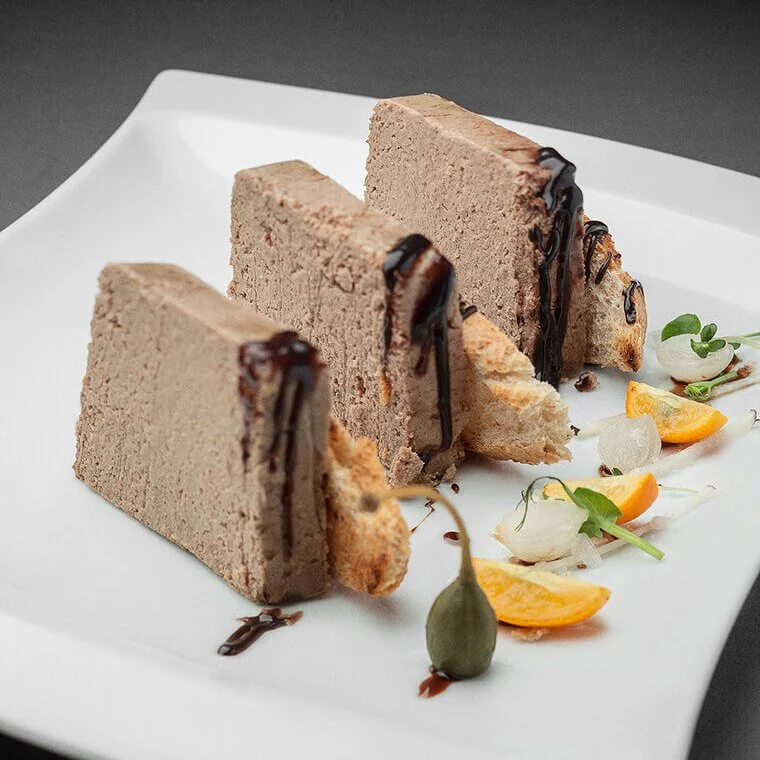
Today on our menu is Liver pate with beef brains and caramelize red bilberry. Tasty, delicate, easy to spread on bread and melting in the mouth.
Pate – is specially cooked minced meat, poultry, game, eggs, mushrooms and other products. Make a pate can be of a variety of products, but the leaders remained poultry liver.
As well as about the origin of any dish we argue and argue about liver pate a lot. A priori, it is a French dish, but also claims that the French simply revived the recipe that came up with the ancient Romans. And in the Middle Ages liver pate was the main dish and carried with full honors and luxury. Even happened bird flew out of it. Well, it was fashionable during that times;) Pate was considered as a real delicacy for a long time, and only aristocrats was able to eat it. In today’s world situation has changed and now the pate put into mass production. But, nevertheless, to find the most delicious liver pate is very difficult. However, if you want to try an aristocratic liver pate, you can cook it at home.
Ingredients
Method
- Mix the lingonberries with the wine in the small saucepan and leave them for 1 hour.
- Heat the oven to 150°C (300°F) and boil a kettle of water.
- Line the loaf tin with baking paper.
- Pat the livers dry with paper towels.
- Melt 50 g of butter in the frying pan over medium heat and fry the bacon and onion for 3–4 minutes, until the onion is soft.
- Add the livers and fry for 1–2 minutes on each side, until browned outside and still pink inside.
- Tear the bread into small pieces and soak it in the cream for 5 minutes.
- Blend the livers with everything in the pan until smooth.
- Add the soaked bread and cream, eggs, cognac, anchovy, nutmeg, pepper, salt and the remaining 50 g of soft butter, and blend for 1–2 minutes, until creamy.
- For an extra-smooth pâté, push the mixture through the sieve.
- Pour the mixture into the lined tin, tap it on the counter to release air bubbles and cover with foil.
- Set the tin in the roasting tin and pour in hot water to come halfway up its sides.
- Bake for 45–60 minutes, until the pâté is just set and a thermometer in the centre reads 70°C (158°F).
- Lift the tin out of the water and let it cool for 1–2 hours.
- Refrigerate the pâté for at least 4 hours, or overnight.
- Add the sugar and cinnamon to the soaked lingonberries and simmer for 10–12 minutes, until the berries burst and the syrup coats a spoon.
- Let the lingonberries cool; they thicken further as they cool.
- Heat the oven to 180°C (350°F).
- Slice the baguette very thinly, brush the slices with olive oil and bake on the baking sheet for 8–10 minutes, until crisp.
- Turn out the pâté and cut it into 1.5 cm slices with a knife dipped in hot water.
- Serve each slice with a spoonful of lingonberries, baguette crisps, microgreens and, if you like, a few edible flowers.
- Remove the foil from the liver and brain.
- Bacon and onion we shall cut in small cubes and fry in butter for 2-3 minutes.
- Add the liver and brain, fry for 1-2 minutes on all sides.
- Cut toast bread in cubes. Put in a blender the liver and brain. Beat.
- Add the bread, cream, cognac, eggs, nutmeg, anchovy and beat until it will be creamy.
- Turn into a rectangular form. Fill the pan with hot water to a depth of 3-5 cm. Bake liver pate on a steam bath for 45 minutes at a temperature of 125 degrees. Ready pate cools in form for 1-2 hours.
- red bilberry soaked in wine for 1 hour, add sugar and cooked to caramel.
- Ready liver pate cut into pieces, put on a plate, add baguette chips and cranberries.
- Beef brains replaced with 180 g extra liver and 50 g butter Brains are rarely sold, and in some countries not at all. Extra liver and butter keep the creamy texture, though the pâté tastes more strongly of liver.
- Duck liver can be replaced with chicken livers Chicken livers are in every supermarket and give a milder pâté.
- Oven set to 150°C (300°F) and the pâté cooked until 70°C (158°F) in the centre A professional convection oven at 125°C (257°F) is gentler and more even than most home ovens. Liver, chicken liver especially, must reach 70°C to be safe; a thermometer tells you when it has.
- Written for 8 servings, in a 1 litre loaf tin The technical card is headed 'per portion', but the quantities fill a whole terrine.
- Lingonberries cooked to a thick syrup rather than 'to caramel' Cooking berries until the sugar caramelises would burn them; the chef's result is a glossy, jammy compote. Frozen lingonberries or cranberries both work.
- Salt added to the list (½ tsp) The chef's technical card includes 3 g of sea salt; the list on the old site left it out.
- Mixture pushed through a sieve, optionally It removes any sinew and gives the silky texture of a restaurant pâté.
The dish in the photograph was cooked by the restaurant for this story. Photo: Oleksandr Slyadnyev.