
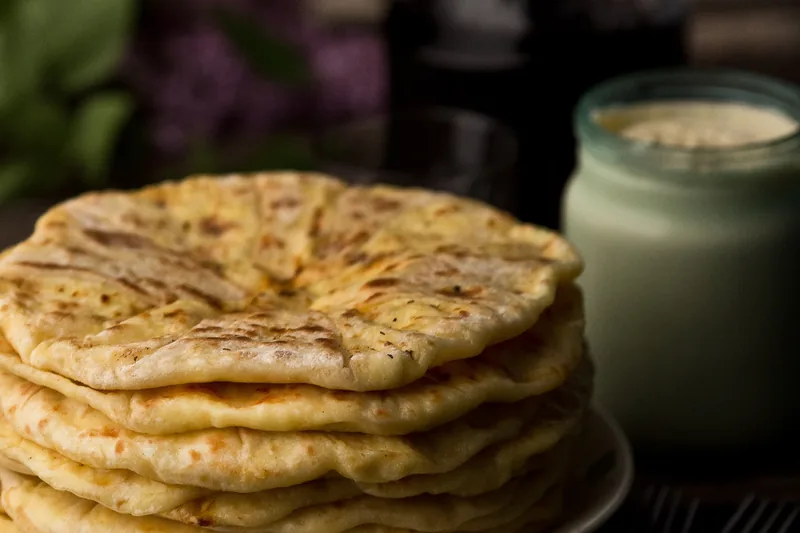
Placinta, or Romanian Placenta Cake, is a traditional dessert that features layers of thin, flaky dough filled with sweet and tangy cheese, often with a touch of vanilla or citrus zest. Its name "placenta" comes from the Greek word for "cake," though the dessert is entirely Romanian in origin. The dough is carefully rolled out and layered, before being filled with a mixture of sweet cheese and sometimes sour cream, then baked to golden perfection. The result is a warm, comforting dessert with a slightly crispy exterior and a rich, creamy filling.
This cake is perfect for cozy gatherings, particularly during the fall and winter seasons when the weather calls for indulgent treats. It pairs wonderfully with a cup of tea or coffee and is often served during holidays or family celebrations. The balance of textures and the delightful sweetness of the filling make it a perfect dessert to share during the colder months.
Ingredients
Method
- Stir the salt into the kefir.
- Sift 300 g of the flour with the baking soda into the large bowl and make a well in the middle.
- Pour in the kefir, stir and then knead for 3–4 minutes into a soft, elastic dough that just stops sticking, adding up to 50 g more flour if needed.
- Cover the dough and leave it to rest for 20–30 minutes.
- Mash the cheese with the egg, salt and dill until fairly smooth.
- Divide the dough into 4 pieces and roll each on a floured surface into a thin round about 20 cm across, as thin at the edges as in the middle.
- Spread a quarter of the filling over the middle of each round, leaving a 5 cm border.
- Fold the edges over the filling towards the centre so they overlap, like an envelope, and press the seams.
- Turn each one seam-side down and flatten it gently with your palm to about 1.5 cm thick.
- Heat the dry frying pan over medium heat and cook two plăcinte for 2 minutes per side, until set and lightly coloured.
- Lower the heat, cover the pan and cook for 5–6 minutes per side, until puffed, golden and cooked through.
- Melt the butter over low heat without stirring.
- Brush the plăcinte generously with butter as soon as they come out of the pan, stack them and cook the other two.
- Serve warm, with sour cream if you like.
- Sift the flour with baking soda.
- Make the well in the center; pour in the liquid, season to taste.
- Knead the dough (it should be soft and elastic).
- Set it aside for some time.
- While the dough is rising, prepare the filling.
- Combine Cottage Cheese with eggs and salt, stir it until smooth (you can add some chopped greens if desired, - dill will be perfect there).
- Divide the dough into 4 equal parts.
- Roll each patty into a circles (the edges should be as thin as the middle).
- Place a generous amount of the filling in the middle of each circle, and spread it a bit.
- Fold the edges, then flatten it slightly.
- Fry plăcintăs on the large pan over medium heat at the start, then reduce the heat to low, and fry on both sides until cooked.
- Melt the butter over low heat (don’t stir it).
- Generously grease plăcintăs with melted butter.
- Amounts given for the flour, cheese, egg and salt The original lists them without quantities.
- Butter added to the list (50 g) The method brushes the plăcinte with melted butter, but the list leaves it out.
- Resting time given: 20–30 minutes The original says 'for some time'. A soda dough does not rise like a yeast dough; the rest relaxes it so it rolls thin.
- Frying times given, with a lid over low heat The chef starts over medium heat and then lowers it; a lid helps the thick middle cook through before the outside burns.
- Cottage cheese drained, or replaced with farmer's cheese Wet cottage cheese makes the filling runny and the dough soggy; dry farmer's cheese (tvorog, brânză de vaci) is closest to what the chef uses.
The dish in the photograph was cooked by the restaurant for this story. Photo: Oleksandr Slyadnyev.