
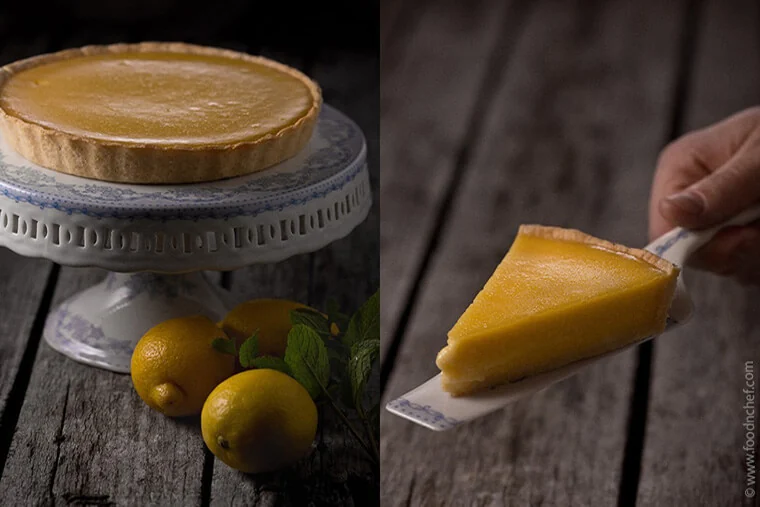
I adore messing around with pastries. There is nothing more interesting than to bake something tasty and as harmful. I have already written that if I didn’t become a photographer, most likely would have chosen the profession of pastry chef or baker. But this recipe of lemon pie is one of my favorite recipe. Since then I first tried it, cooked it about a dozen times.
Ingredients
Method
- Rub the flour, salt, sugar and cold butter together with your fingertips until the mixture looks like fine crumbs.
- Add the egg and bring the dough together quickly, without kneading; add 1 tsp of cold water only if it stays crumbly.
- Flatten the dough into a disc, wrap it in cling film and refrigerate for 1 hour.
- Roll the pastry out on a floured surface to 3 mm thick.
- Cut 4 circles about 3 cm (1¼ in) wider than the tins and line the tins, pressing the pastry into the edges and letting the excess hang over.
- Prick the bases with a fork and refrigerate the lined tins for 20 minutes.
- Heat the oven to 170°C (340°F).
- Line each tartlet with baking paper and fill with baking beans.
- Bake on the baking sheet for 15 minutes, then lift out the paper and beans.
- Bake for 8–10 minutes more, until the pastry is golden and dry.
- Trim the overhanging pastry with a sharp knife while still warm and let the shells cool.
- Finely grate the zest of both lemons and squeeze 70 ml of juice.
- Whisk the eggs, cream, sugar, lemon zest and juice gently in the heatproof bowl, without making foam.
- Set the bowl over a pan of barely simmering water and stir constantly for 8–12 minutes, until the filling reaches 80°C (176°F), thickens slightly and gives off the first wisps of steam.
- Take the bowl off the heat and let the filling cool to room temperature.
- Strain the filling through the fine sieve.
- Heat the oven to 120°C (250°F).
- Set the tartlet shells on the baking sheet and pour in the filling almost to the rim; pour any extra into the ramekin.
- Bake for 20–30 minutes, until the filling is set at the edges with a slight wobble in the centre.
- Cool the tartlets on a rack, then refrigerate for at least 1 hour before serving.
- Preparation of the pastry:
- Take the flour, butter, salt, sugar and crush with the hands all the ingredients to the formation of shallow crumbs.
- Then add an egg and quickly knead with hands (don’t need kneading the dough for a long time), if necessary, add 1 teaspoon of water.
- Put the pastry in the refrigerator for 1 hour, covered with cling film.
- Roll the pastry out to 28 cm diameter and 5.6 mm thick.
- Line a form with the pastry, so the edges hang down.
- In the pastry prick holes with a fork and coverer with non-stick baking paper.
- Put weights on the top (peas, coins) to the pastry won’t rise up. Bake at 170c degrees until golden brown.
- Cool the form.
- Preparation of citrus filling:
- Wash eggs, and beat with, then add the egg yolk, cream, sugar, zest of 5 lemons, juice.
- In a water bath the mixture reduce to a temperature of about 80 degrees, or until the appearance of steam.
- Remove cream from fire, put to cool.
- When the cream will be cooled fully, tammy it, spill in jars or dessert bowls.
- Preparation of the tart:
- In the chilled form of the pastry pour filling and put in a preheated to 120 degrees oven for 50 minutes.
- Serve at the table.
What we changed for home
- One 28 cm tart replaced with four 10 cm (4 in) tartlets The chef's own source document calls this a lemon mini-tart. Four tartlets make four servings and bake faster, and the full batch of his pastry is the right amount for them.
- Filling cut to a third: 3 eggs, 100 ml cream, 85 g sugar and 2 lemons The original's 9 eggs, extra yolk, 300 g of cream and 250 g of sugar make about 1.2 litres, more than a 28 cm shell holds, which is why its method mentions jars. A third fills four tartlets with a little left for a ramekin; the single extra yolk is dropped.
- Pastry rolled 3 mm thick '5.6 mm' looks like a typo for 5–6 mm, and even that is thick for a tart; 3 mm bakes crisp.
- Lined tins chilled for 20 minutes before blind baking Cold pastry shrinks less in the oven.
- Final bake cut from 50 minutes to 20–30 at 120°C (250°F) Small tartlets set much faster than a 28 cm tart; take them out while the centre still wobbles slightly.
- Thermometer used for the 80°C (176°F) water-bath stage The chef warms the filling to about 80°C (176°F), or until the first steam appears; a thermometer makes the point exact.
The dish in the photograph was cooked by the restaurant for this story. Photo: Oleksandr Slyadnyev.
Screen stays on while you cook